
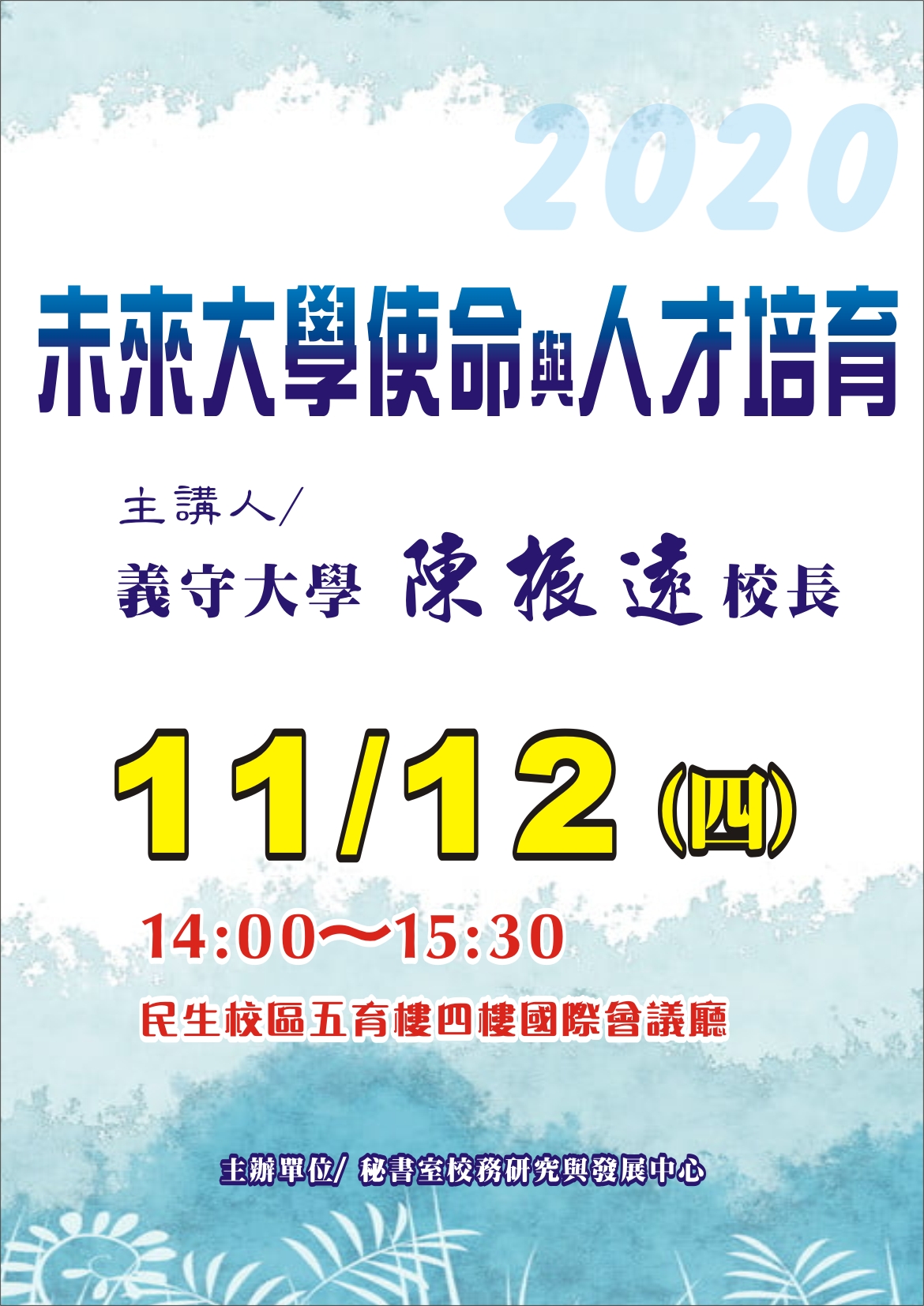
To align with the University’s 2019–2025 Institutional Evaluation and Teaching Quality Assurance Plan and to further implement University Social Responsibility (USR), President Chen Jen-Yuan of I-Shou University was specially invited to visit the University on November 12 to deliver a keynote speech titled “The Mission of Future Universities and Talent Development.” The lecture inspired attending senior administrators to think from multiple perspectives and to strengthen interdisciplinary collaboration, with the expectation of generating more innovative ideas in future professional settings.
President Chen began by addressing the rapid changes in climate, talent development, and technology, emphasizing that universities must cultivate a new generation of talent capable of solving problems through innovative thinking. He also noted that Taiwan is expected to enter a super-aged society by 2026, with technology becoming a key driving force of the era. As technology reshapes the future, it will not only impact higher education but also transform global industrial structures. It is projected that 75 million jobs will disappear worldwide, while 133 million new positions will be created in response to overall environmental changes. Consequently, future employment will no longer be satisfied by a single skill set; instead, there will be an increasing demand for interdisciplinary and cross-domain professionals.
President Chen further proposed several new perspectives on future university education. Foremost among these is a student-centered approach and the cultivation of empathy. While many jobs in the future may be replaced by artificial intelligence, what differentiates humans from AI is the ability to understand others’ emotions and perspectives, as well as to experience and recognize one’s own sense of well-being. These qualities form a crucial foundation of University Social Responsibility. In addition, students should be trained in narrative competence—the ability to clearly articulate and communicate their professional knowledge.
Moreover, universities should provide immersive learning experiences. Lifelong learning is no longer merely about developing interests or passing time; rather, it has become a long-term model for sustaining one’s professional career. Universities must therefore cultivate students’ capacity for self-directed learning so that they can continuously apply what they learn in their workplaces.
President Chen also shared several innovative interdisciplinary teaching and course implementation models. By encouraging collaboration among faculty from diverse academic backgrounds, new ideas and inspiration can be generated. Through flipped teaching and flipped classrooms, students can experience more diverse learning approaches and be better prepared for the future. He also emphasized the promotion of English-medium instruction to enhance global engagement.
With a humorous and engaging delivery, President Chen shared his extensive experience as a university president and institutional leader. His insights provided valuable reference and inspiration for the University’s administrators, stimulating new ideas and perspectives. These exchanges have helped foster innovative thinking for the University, located in the southernmost region of the country, and will contribute to its future development and sustainable management.
https://sec2.nptu.edu.tw/p/406-1158-143152,r1783.php?Lang=zh-tw